How much nature writing exists in social media posts?
Nature writing—i.e. sharing own’s emotions, observations, and notes via text—has by no
means disappeared in the age of the Internet. Instead, what has changed is the context,
and the methods by which emotions and observations are shared. In contemporary times,
for instance, they are spread through social media: Facebook, Instagram, etc. For the
most part, emotions are shared via photos, or their related comments. Indeed,
interaction on social media is primarily visual.
Find social media posts wherein experiences of nature or the environment are described,
and analyse what the characteristic elements of nature writing are that one can find
there.
One possibility is to search for signs of location (geotags) or keywords (hashtags) to
find well-known visiting areas, and to see what people have written about in their
visits to these spots. For instance, one could search for the known places in Estonia
present in Fred Jüssi’s creations and the film Olemise ilu, such as Soomaa,
Kõrvemaa, the Kakerdaja bog, Vilsandi national park, or the island of Vilsandi. Or one
could search for a place known to you, or that is important to you.
Another possibility is to find posts on open social media pages or groups, where people
have likely shared their observations or experiences of nature, such as the groups
Allikalkäijad or Loodusesõbrad on Facebook. Sometimes long descriptions also accompany
photos on the pages for the Estonian Ornithological Society or Matkajad groups.
A third possibility is to Google search some interesting place and find public blog
posts. One of these is Kadri Aller’s (aka Saarehull’s) “Saarehullu päevaraamat” (“Diary
of the Island-crazed”), wherein she tells stories of visiting small Estonian islands.
Find posts, wherein a photo or photos are accompanied by at least a few sentences, to
make it possible to analyse texts.
Here are some examples of social media posts one could examine:
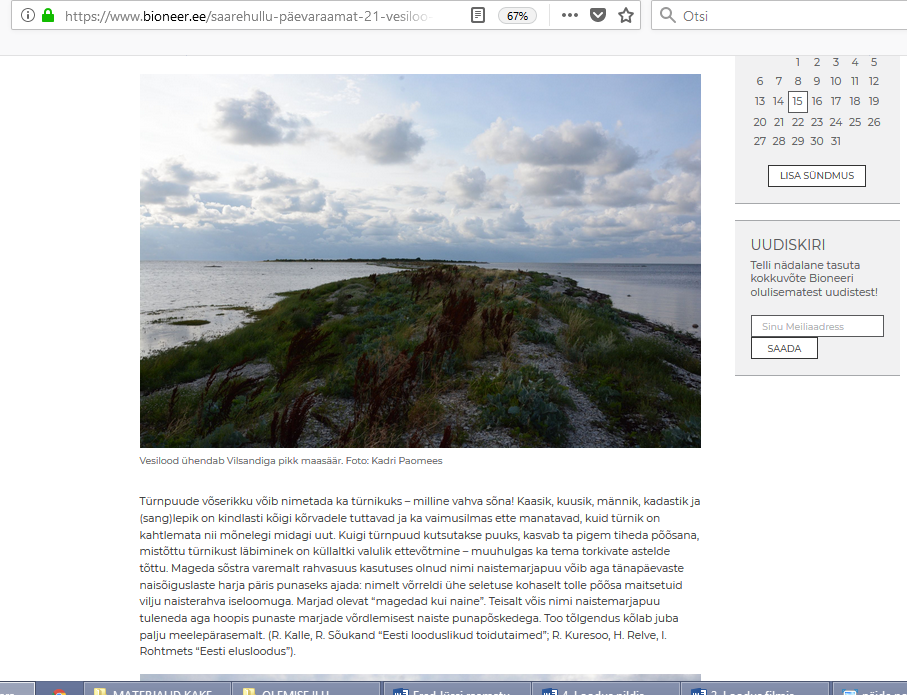
Kadri Aller’s (aka Saarehull’s)
story about the island of Vesiloo
on the website Bioneer.ee.
- The mediation of personal experience. She describes her hike through the water to
reach the island, including bumping into seal flippers, and so on.
- Scientific accuracy. The naming of different species, the use of correct terminology,
exactitude in the description of the island (fossils, plants), the sharing of
information about the nature and local history of the place.
- The attempt to awaken interest in the reader and lead them into nature. The text
attempts to get people to visit the island, and even direct recommendations are given
(she tells hikers to take some time, watch the sea while sitting on a stone and
chewing on some sea cabbage, etc.).
- Local information. The writer attempts to describe the specificities of Vesiloo, many
local names and references are introduced, related to the local heritage and its
stories (for instance, facts about the only person to have ever lived on the
island).
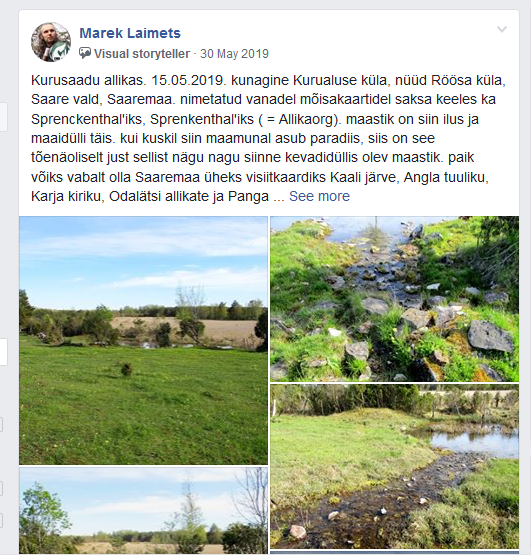
Marek Laimetsa’s post on the Facebook group Allikalkäijad.
- The mediation of personal experience. Description of the local beauty of the place,
the visualisation of experiences.
- Scientific accuracy. The use of correct terminology, the use of special place
names.
- Literary techniques or an artistic style. The place is compared to paradise.
- Local information. Names places and describes the uniqueness of the area.
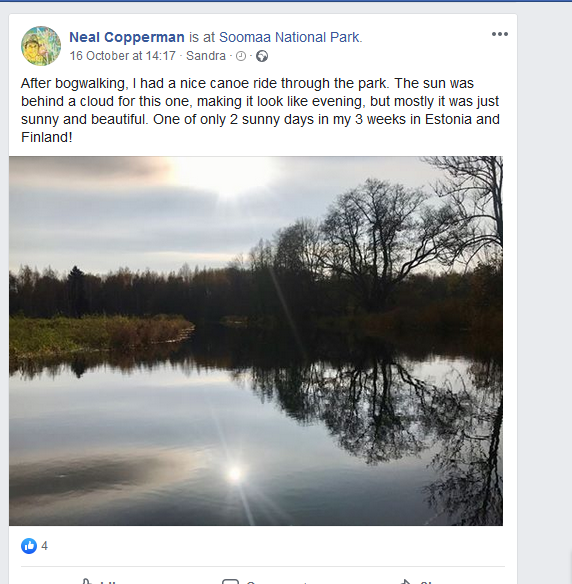
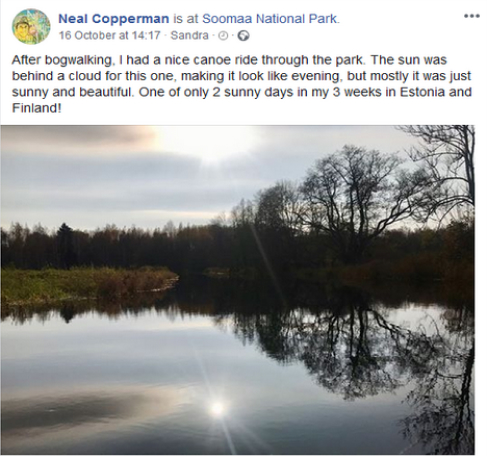
Neal Copperman’s post about the Soomaa national park with geotag.
- The mediation of personal experience. Description of the place’s beauty, the mention
of canoeing.
- Literary techniques or an artistic style. The expression of emotion via evaluative or
value-based vocabulary.